
Brackets
Elza Mou
Brackets
Brackets are a key element in certain orthodontic devices
Used to align a patient’s teeth. Technically, the term «bracket» relates to each of the teeth held by a metal arch attached to the front or back surface of the tooth. They are usually made of metal, although brackets made of other materials exist, such as ceramic, sapphire glass or resin, and they are adjusted to the surface area of the teeth.
Their objective is to correct or eliminate certain defects related with the patient’s bite or the alignment of their smile, such as crowded teeth, open or crossed bite, separations between teeth (technically known as diastemas) or overbites, among others.
They have three components:
- Brackets
- Ligatures
- Metallic arch
The metallic arch is the active part of the apparatus, which really exercises the force necessary to push the teeth to the position they should occupy. The function of the brackets is simply to transfer the necessary force to the arches for them to be really effective.
Types of brackets
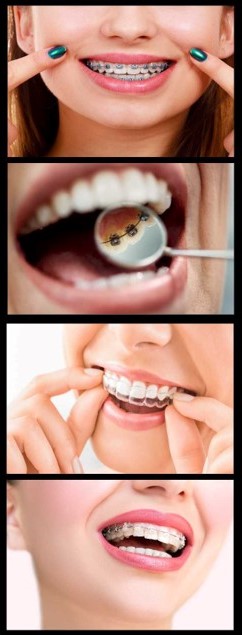
There are different types of brackets, according to their form, position within their teeth and their aesthetics:
Metallic brackets
These are the traditional brackets, which have been the most used over recent years thanks to their effectiveness in correcting defects and malocclusions. Although they represent the most effective orthodontic treatment, they can also be the most anti-aesthetic, since they are placed on the front of the teeth.
Aesthetic brackets
This type of orthodontics is also placed on the front part of the teeth, but they usually go unnoticed since they are made of materials such as ceramic, resin or sapphire. The material in which they are made is a more faithful imitation of the natural aspect of teeth and they are much more discreet than metallic ones.
Lingual brackets
We talk about orthodontics that are invisible to the eye, since they are placed on the inside of the teeth. They have gained prominence in recent years, thanks to their aesthetics, since they cannot be seen and therefore no one notices that the patient is wearing them.
Self-ligating brackets
Unlike conventional brackets, self-ligating brackets use a clip mechanism that holds the arch, eliminating the need for ligatures and thereby generating less friction for the teeth. They use materials similar to non-self-ligating brackets and some are more discreet and aesthetic, such as ceramic or plastic brackets, which go unnoticed.